Introduction:
Identifying multiphase flow patterns is crucial across various industries, such as pipeline transport, reactor safety, electronics cooling, and medical diagnostics. Multiphase flows consist of distinct phases: liquid, gas, or solid that interact dynamically. Recognizing these flow patterns (such as bubbly, slug, annular, and laminar) is essential for understanding and optimizing processes like boiling, condensation, and chemical mixing.
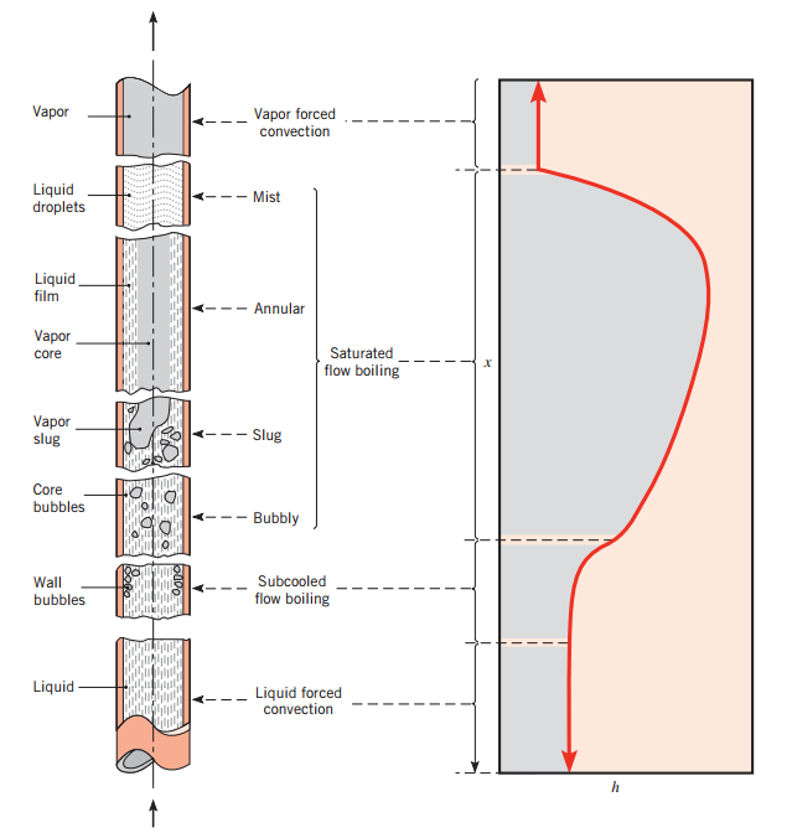
The flow regimes depend on several factors, including fluid properties, flow rates, and geometrical constraints. The integration of computer vision and machine learning enhances these processes by automating tasks, improving accuracy, and enabling scalability in analyzing complex fluid dynamics.
Equations:
There are four primary approaches for deriving equations related to multiphase flow, which can be chosen based on the specific application, scale, and required level of accuracy.
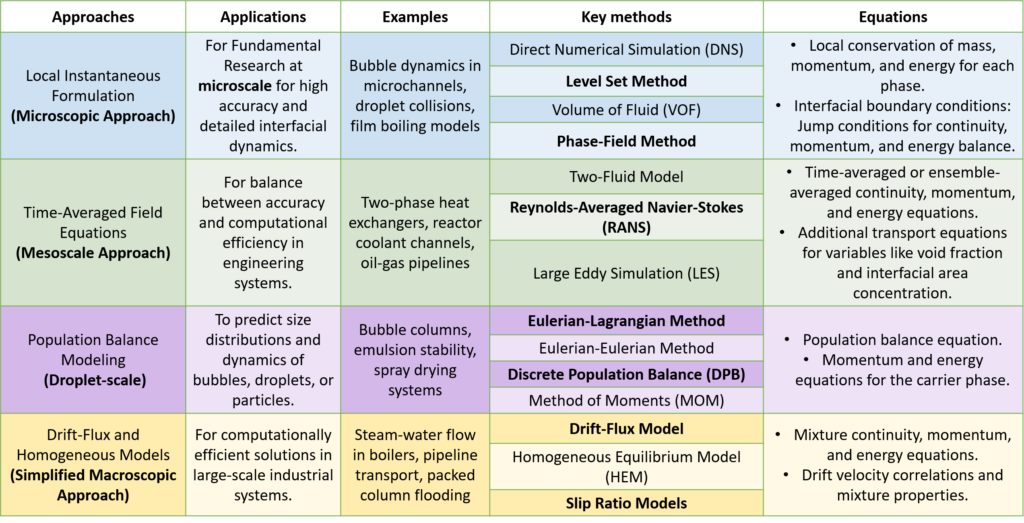
Formulations for mesoscale physics can be classified into distinct categories based on the computational methods, focus areas, and techniques used to model the behavior of multiphase flows at the mesoscale level. Here’s a list summarizing the classifications:
Population Balance Models track the size distribution and evolution of dispersed phases, such as bubbles or droplets. This method’s key applications are bubble coalescence, breakup, and size distribution in Bubble columns or chemical reactors.
Eulerian-Eulerian Models treat all phases as interpenetrating continua and solve conservation equations for each phase. Key Applications of this method are dense flows or pipeline flows, fluidized bed reactors, and bubble columns.
Lagrangian Models track individual particles, bubbles, or droplets and incorporate detailed particle interactions. Key Applications of this method include diluted flows, particle trajectories, particle separators, and Aerosol spray formation.
VOF (Volume-of-Fluid) focuses on tracking interfaces between immiscible phases, resolving interfacial dynamics. Key Applications of this method are Multiphase flows with sharp interfaces, microfluidic devices, and bubble dynamics in Boiling systems.
Discrete Element Method (DEM) simulates particulate interactions with detailed collision and contact mechanics. Key Applications of this method include granular flows in Pharmaceutical mixing, as well as particle-particle and particle-fluid dynamics.
Hybrid Methods combine models, such as Eulerian-Eulerian with population balance or Lagrangian approaches. Key Applications of this method include capturing multiscale interactions in complex systems, such as multiphase reactors and hydrocyclones.
Interfacial Area Density Models quantify changes in interfacial area due to coalescence or breakup at the mesoscale. This method has key applications in Heat and mass transfer enhancement studies in Gas-liquid absorption or evaporation units.
Turbulence Closure Models integrate turbulence effects at the mesoscale, k−ϵ, or LES frameworks. This method’s key applications are modeling flow patterns in turbulent multiphase flows, such as Chemical mixers or combustion chambers.
Flow Pattern Recognition Framework:
- Identify System Type: Boiling systems, condensation systems, mixing tanks, pipelines, and other similar systems.
- Determine Operating Conditions: Phase velocities, pressure, temperature, flow orientation.
- Classify Flow Patterns: Use experimental observations or simulations to map the flow regime.
Implementation:
The methods for identifying multiphase flow patterns can be broadly categorized into several approaches.
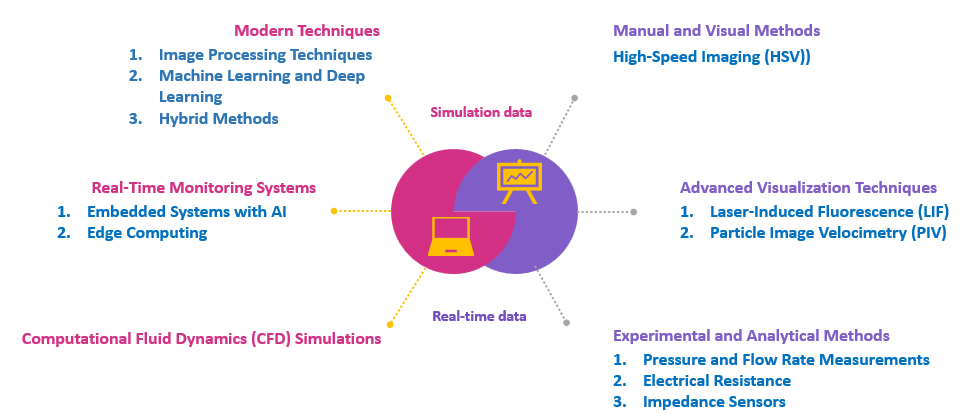
Computer vision is a versatile tool that can adapt to both manual and automated workflows, making it essential for identifying multiphase flow patterns. The Computer Vision (CV) method used for identifying these patterns primarily falls into the following categories:
- Image Processing Techniques (Thresholding and Segmentation, Feature Extraction)
- Machine Learning and Deep Learning ( Convolutional Neural Networks (CNNs), Transformer Neural Networks (TNNs), Physics-Informed Neural Networks (PINNs))
- Hybrid Methods (Data Fusion, Coupling CFD with Machine Learning)
For the identification of multiphase flow using Computer Vision (CV), certain cases are particularly relevant because they involve visual features that can be captured and analyzed with imaging techniques. Here is a breakdown of the most important cases:
- Flow Regime Identification
- Bubble Size and Distribution
- Phase Distribution
- Coalescence and Breakup Dynamics
- Droplet Dynamics
- Interfacial Area Measurement
- Void Fraction Estimation
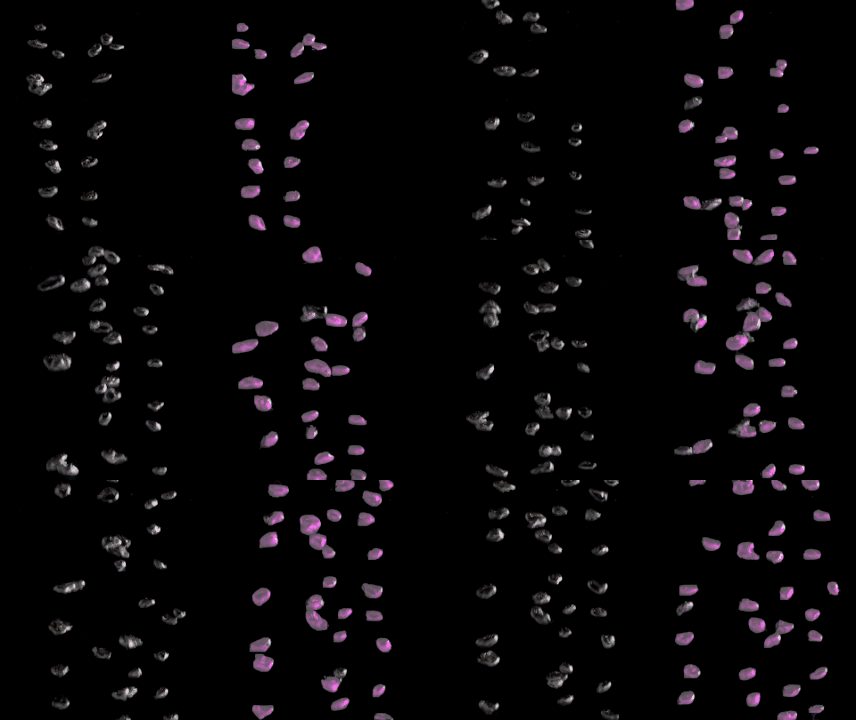
Based on the principles of computer vision, image processing, Machine Learning, Deep Learning, and Hybrid Methods, we can outline how to identify multiphase flow patterns in each of these cases. For example, the following video was created by the BubMask package, which is based on Mask R-CNN using ResNet-101 as the backbone and applied transfer learning from pre-trained COCO weights:
This package has been updated to run with the latest dependencies and Nvidia drivers. The original data for bubble detection can be found here.
Bubble Size and Distribution
Goal: Detect, measure, and track bubbles to understand their growth, dynamics, and interactions.
Techniques:
- Image Processing: For “Watershed Segmentation,” we can separate overlapping bubbles. Then, “Hough Transform” can detect circular features (for near-spherical bubbles).
- Machine Learning & Deep Learning: We can use CNN-based Object Detection for real-time bubble detection and classification. Then PINNs can learn the bubble growth dynamics using physics-based constraints.
- Hybrid Methods: We can use “Data Fusion” to combine X-ray imaging and optical imaging to extract accurate bubble sizes from multiple perspectives.
References:
- Theodore L. Bergman, Adrienne S. Lavine, Frank P. Incropera, David P. DeWitt – Fundamentals of Heat and Mass Transfer-Wiley (2017)-620-639. ↩︎
- Multiphase Flow Analysis Using Population Balance Modeling, 2014. Elsevier. https://doi.org/10.1016/C2011-0-05568-0 ↩︎
- Kolev, N.I., 2012. Multiphase Flow Dynamics 2. Springer Berlin Heidelberg, Berlin, Heidelberg. https://doi.org/10.1007/978-3-642-20598-9 ↩︎
- Ishii, M., Hibiki, T., 2006. Thermo-fluid dynamics of two-phase flow. Springer Science+Business Media, New York, N.Y. ↩︎
Leave a Reply